
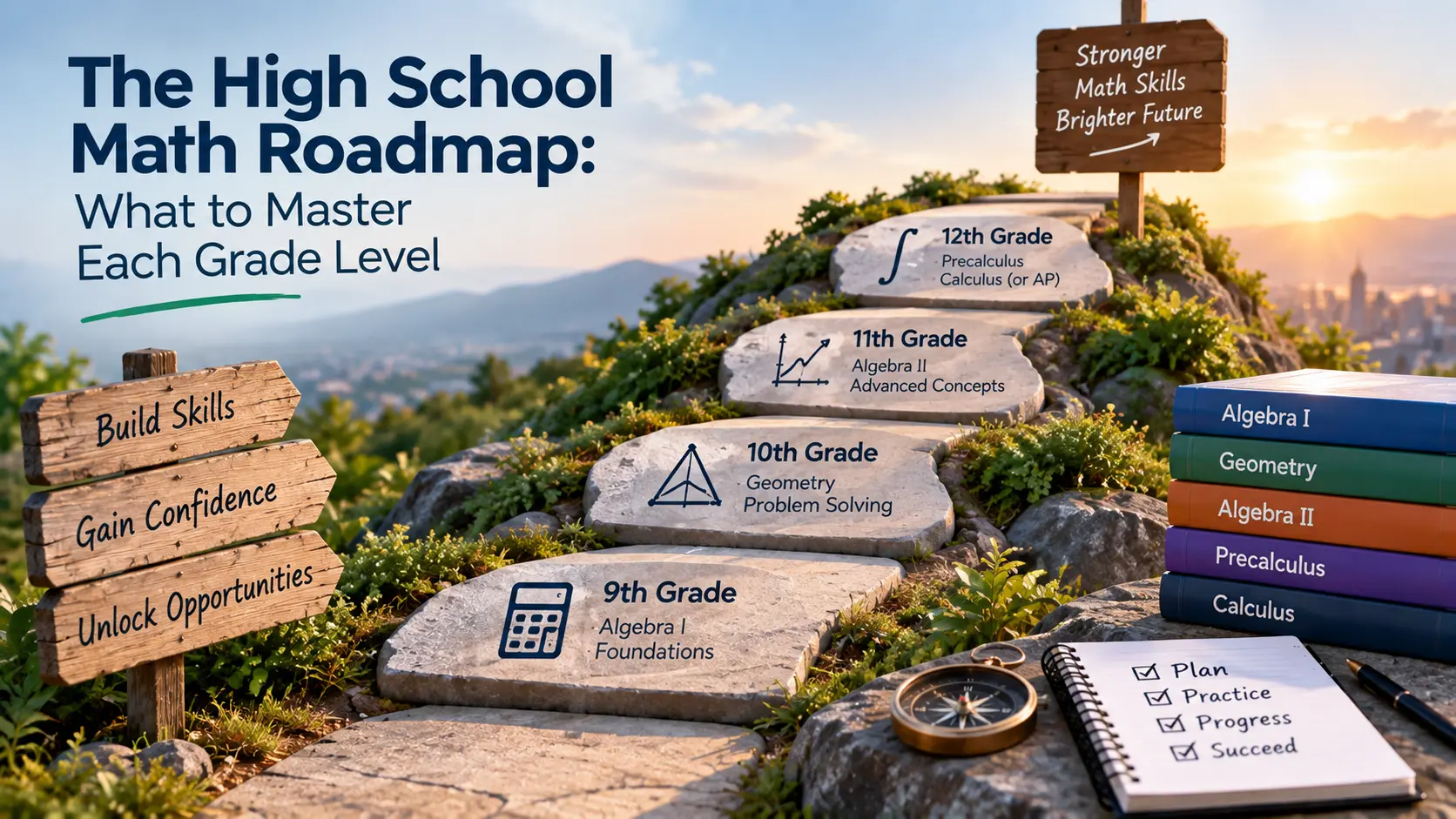
The High School Math Roadmap
High school math can feel like a maze to parents. Algebra 1, Geometry, Algebra 2, Precalculus, the names blur together, and it is hard to know whether your child is on track, ahead, or quietly falling behind. Add in honors sections, AP options, and the fact that every school seems to arrange things a little differently, and the confusion is understandable.
This high school math roadmap lays it out clearly. It shows the standard sequence, what your child should actually master at each stage, and how it all connects to college. Think of it as a map you can check your child against, so you know what is coming and what matters most.
The Standard High School Math Sequence
Most US high schools follow one main path. Each course is a prerequisite for the next, which is why the order rarely changes and why gaps are so costly.
The typical sequence is:
Algebra 1, then Geometry, then Algebra 2, then Precalculus, then Calculus or Statistics.
A few things are worth knowing right away. Most colleges expect students to complete at least through Algebra 2. Competitive programs, especially engineering, computer science, and pre-med, often prefer to see Calculus or Statistics as well. And most high schools require three years of math to graduate while recommending four, so taking math all four years keeps the most doors open.
One note on scheduling. Some schools use Integrated Math (often labeled Math 1, 2, 3) that blends algebra, geometry, and statistics together instead of separating them. The content is largely the same, just arranged differently. If your child’s school uses this system, the mastery goals below still apply, they are just spread across the integrated courses.
Before High School: The Foundation That Decides Everything
The roadmap really starts before ninth grade. By the end of middle school, a student should be fluent in fractions, decimals, percents, negative numbers, and basic pre-algebra like simple equations and order of operations.
This matters more than any single high school course, because high school math is cumulative and unforgiving of gaps. A student shaky on fractions will struggle in Algebra 1 no matter how hard they work, because algebra uses those skills constantly. If your child is entering high school with weak fundamentals, addressing that now is the highest-value thing you can do.
Some accelerated students take Algebra 1 in 8th grade. That shifts their whole sequence forward a year and puts Calculus within easy reach by senior year. It is a good option for strong, ready students, but readiness matters more than ambition. Rushing a student who is not solid on the fundamentals backfires.
9th Grade Algebra 1, the Gateway
Algebra 1 is the foundation of all high school math, and arguably the most important course of the four years. Everything after it assumes mastery of what happens here.
What to master: working with variables and expressions, solving linear equations and inequalities, graphing lines and understanding slope, systems of equations, exponents, polynomials, factoring, and quadratic equations.
This is the gatekeeper course. Struggling here does not just hurt one grade, it undermines every math class that follows. If your child is going to get focused support at any point, this is the stage where it counts the most. Do not let shaky spots slide in ninth grade, because they compound.
Seek2Lrn Tip
Watch Algebra 1 closely even if the grade looks acceptable. A C in Algebra 1 often hides gaps that will surface painfully in Algebra 2 two years later. It is far easier to shore up a weak spot now than to rebuild it under the pressure of a harder course later on.
10th Grade Geometry, a Different Kind of Thinking
Geometry is a bit of a change of pace. Instead of manipulating equations, students study shapes, angles, proofs, and spatial reasoning. Some students who found algebra hard actually thrive here, and some who loved algebra find proofs frustrating.
What to master: properties of triangles, circles, and other figures, congruence and similarity, the Pythagorean theorem, area and volume, and the logic of writing a proof. Coordinate geometry, which connects shapes back to algebra, is especially important.
One thing to know: geometry introduces the right-triangle relationships that become trigonometry later. A student who grasps these now has an easier time in Precalculus. Geometry also keeps algebra skills alive through coordinate work, so they do not rust before Algebra 2.
11th Grade Algebra 2, Where It Gets Serious
Algebra 2 is where high school math deepens significantly. It revisits algebra at a higher level and adds the function families that college math and standardized tests lean on heavily.
What to master: quadratic, polynomial, exponential, logarithmic, and rational functions, complex numbers, systems, and often an introduction to trigonometry and statistics.
This course matters enormously for two reasons. First, it is the level most colleges expect every applicant to reach. Second, its content shows up all over the SAT and ACT, so a strong Algebra 2 foundation directly helps test scores. If your child is college-bound, this is a course to take seriously and not just pass.
12th Grade: Precalculus, Calculus, or Statistics
Senior year math depends on your child’s path and pace.
Precalculus bridges Algebra 2 and Calculus, going deep on functions and trigonometry. Students aiming for a STEM major or Calculus need it.
Calculus, often AP Calculus AB or BC, is the goal for STEM-bound students and looks strong on college applications. It introduces limits, derivatives, and integrals, the foundation of college-level math and science.
Statistics, often AP Statistics, is an excellent choice for students headed toward business, social sciences, medicine, or any data-heavy field. It is not a lesser option, just a different and often more practical one for non-engineering paths.
There is no single right senior-year course. A future engineer should aim for Calculus. A future psychology or business major may be better served by Statistics. Match the course to where your child is going.
How to Use This Roadmap as a Parent
You do not need to become a math expert. You need to know three things: where your child is on the map, whether they have truly mastered each stage before moving on, and where they are headed.
The most common mistake is treating a passing grade as proof of mastery. Because math builds relentlessly, a student who scraped through one course carries those gaps into the next, where they get heavier. Check for real understanding, not just a grade, especially in Algebra 1 and Algebra 2, the two courses everything else depends on.
If your child hits a wall at any stage, deal with it before the next course begins rather than hoping it resolves itself. A tutor can help identify exactly where the understanding breaks down and close the gap before it compounds. Seek2Lrn is one option for that kind of targeted, personalized support, matched to wherever your child actually is on the roadmap.
The Takeaway
The high school math roadmap is simpler than it looks: Algebra 1, Geometry, Algebra 2, then Precalculus, Calculus, or Statistics, each building on the last. Aim for at least Algebra 2 for college, and Calculus or Statistics for competitive and STEM paths.
The real secret is not speed, it is mastery. A student who genuinely understands each stage before moving on will go further, with less stress, than one who races ahead on a shaky foundation. Use this map to keep your child on solid ground, and the rest of the journey gets a great deal smoother.
Related reading: why students fall behind in algebra, should I take AP Calculus BC.
