
Breaking Down How to Prepare for the SAT
The first time most students open the SAT syllabus, the reaction is the same. The scoring looks confusing, the sections feel huge, and the whole thing seems like a mountain of material to memorize. Take a breath. The SAT is not a memory contest. It rewards a clear plan, steady practice, and knowing how the test actually works. Students who understand that walk in calmer and score higher than students who simply studied harder.
This guide walks you through everything you need to prepare for the 2026 Digital SAT, from the format to a realistic study plan to what to do in the final month. Follow it step by step and the mountain starts to look like a staircase.
What Is SAT and Why Does It Matter in 2026?
The SAT is a standardized test used by colleges to measure how ready a student is for university level work. It gives admissions officers one common yardstick to compare applicants from thousands of different schools.
Even with many colleges going test-optional, the SAT still matters. A strong score can lift an application, help you stand out, and open doors to merit scholarships that quietly save families thousands of dollars. Plenty of universities in the US, Canada, and around the world still accept and value SAT scores, and some have started requiring them again.
Since 2024, everyone takes the Digital SAT. It runs on the College Board’s Bluebook app, not on paper. The digital version is shorter, faster to score, and adapts to how you perform as you go. The score scale has not changed, so colleges read your result exactly as they always have.

Understand the New SAT Format
Reading and Writing Section
This section has 54 questions and covers reading comprehension, grammar, sentence structure, and vocabulary used in context. Passages are short, often a single paragraph, with one question each. You are not reading long essays anymore. You read a small chunk, answer, and move on.
Math Section
The Math section has 44 questions and covers algebra, advanced math, problem solving and data analysis, and a bit of geometry and trigonometry. A built-in Desmos graphing calculator is available for every math question now. The old no-calculator section is gone.
Timing and Question Structure
Each section is split into two modules.
- Reading and Writing: two modules, 32 minutes each, 64 minutes total
- Math: two modules, 35 minutes each, 70 minutes total
That comes to about 2 hours and 14 minutes of actual testing, plus a 10-minute break between the two sections. Each module has its own clock. You cannot save leftover time from one module and spend it on the next.
Adaptive Testing System
The Digital SAT is section-adaptive, which is the biggest shift from the old test. Module 1 of each section is the same for everyone. How you do on Module 1 decides whether Module 2 gives you harder or easier questions. The harder path carries a higher score ceiling, so early accuracy matters a lot. Treat Module 1 as the most important part of each section, not a warm-up.
Scoring Pattern
Your total score ranges from 400 to 1600, made up of two section scores between 200 and 800 each. There is no penalty for wrong answers, so never leave a question blank. A rough guess is always better than nothing. Scores usually arrive within about two weeks.
Seek2Lrn Tip: Take at least one full practice test inside the Bluebook app before test day. Practicing on paper builds the wrong habits. The screen, the timing, and the Desmos calculator all feel different, and getting comfortable with the real interface removes a surprising amount of test-day nerves.
Create a Realistic SAT Study Plan
The best study plan is the one you can actually stick to. Start with a diagnostic practice test to find your baseline, then build backward from your test date.
Three-Month Plan
If you have about twelve weeks, split them into three phases.
- Weeks 1 to 4: Learn the format and rebuild weak fundamentals in both sections.
- Weeks 5 to 8: Drill specific question types and start timed modules.
- Weeks 9 to 12: Take full practice tests every week and focus on reviewing mistakes.
Six-Month Plan
With more time, you can go slower and deeper. Spend the first two months strengthening core skills, the middle two months on targeted practice and strategy, and the final two months on full length tests and fine-tuning. This is the most comfortable timeline and suits students balancing SAT prep with schoolwork.
Weekly and Daily Routine
Aim for a steady rhythm rather than occasional cramming.
- Weekly: 3 to 5 focused study sessions, one timed section or module, and one review session.
- Daily: 45 to 90 minutes. Warm up with a few questions, work on one skill, then review what you got wrong.
Consistency beats intensity every time. An hour a day for three months does far more than a panicked weekend before the test
Seek2Lrn Tip: Schedule your study sessions like real appointments and put them on a calendar. A fixed time slot removes the daily debate about when to study, and protecting even 45 minutes at the same time each day builds a habit that sticks.
Build Strong Reading and Writing Skills
This section rewards careful reading and a solid grasp of grammar. You can improve faster here than most students expect.
- Reading comprehension: Read the question first, then the passage. Look for the main idea and the author’s purpose rather than getting lost in details.
- Grammar rules: Learn the handful of rules the test repeats constantly, like subject-verb agreement, punctuation, and sentence boundaries. These show up again and again.
- Vocabulary in context: The test cares about how words function in a sentence, not obscure definitions. Practice figuring out meaning from the surrounding text.
- Time management: With roughly a minute per question, trust your first read, mark anything tricky, and keep moving.
Seek2Lrn Tip: If one question type keeps tripping you up, that is exactly where a tutor or guided practice pays off. A good tutor spots the pattern behind your errors in minutes, something that is hard to see on your own, and gives you a fix you can apply right away.
Improve Your SAT Math Score
Math rewards recognizing patterns and knowing your tools. Focus your energy where the points are.
- Algebra: This is the backbone of the section. Get comfortable with linear equations, systems, and inequalities, since they appear often.
- Advanced math: Quadratics, functions, and exponents. Algebra and advanced math together make up most of the section, so give them the most attention.
- Problem solving and data analysis: Ratios, percentages, rates, and reading graphs and tables.
- Geometry and trigonometry: A smaller slice of the test, but worth reviewing basic area, angle, and triangle rules.
- Calculator strategy: Desmos is powerful, but only if you practice with it. Learn to graph equations, find intersections, and solve systems visually to save time on hard questions.
Seek2Lrn Tip: Do not just grind through hundreds of random problems. Sort your practice by topic, hammer your weakest one until it clicks, then move to the next. Targeted practice on a single weak skill raises your score faster than scattered mixed sets.
Practice With Full-Length Mock Tests
Practice tests are where preparation turns into a real score. They build the stamina and pacing you cannot get from short drills.
- Why they matter: They train your focus across four modules and get you used to the screen, the timer, and the pressure.
- How often: Once every two to three weeks early on, then weekly in the final month.
- How to analyze mistakes: This is the most valuable step. For every wrong answer, ask why you missed it. Was it a content gap, a careless error, a timing rush, or a trap answer? Fix the cause, not just the question.
- Building stamina: Sit full tests under real conditions so two-plus hours of focus feels normal by test day.
Seek2Lrn Tip: Keep an error journal. Write down every question you miss, the reason, and the correct approach. After a few weeks, patterns jump out, and fixing one recurring mistake can lift your score more than a dozen new practice sets.
Best SAT Resources for 2026
You do not need to buy everything. A few strong resources beat a shelf of unused books.
- Official SAT resources: Start with the College Board’s free full-length adaptive practice tests inside Bluebook. They use the exact interface you will see on test day, so nothing beats them for realism.
- Free practice: Khan Academy’s official SAT practice is free and tied to the College Board.
- Study apps: Question-bank and flashcard apps are handy for short daily drills between
longer sessions. - Books: A current 2026 Digital SAT prep book is useful for structured content review, as
long as it covers the digital format. - Online tutoring: When self-study stalls, a tutor gives you feedback and a plan tailored to
your gaps.
Seek2Lrn Tip: Reach for personalized guidance when your score plateaus or when you keep missing the same things despite studying. That is the signal that you need an outside eye, not more solo hours. A tutor can break the plateau by targeting exactly what is holding you back.
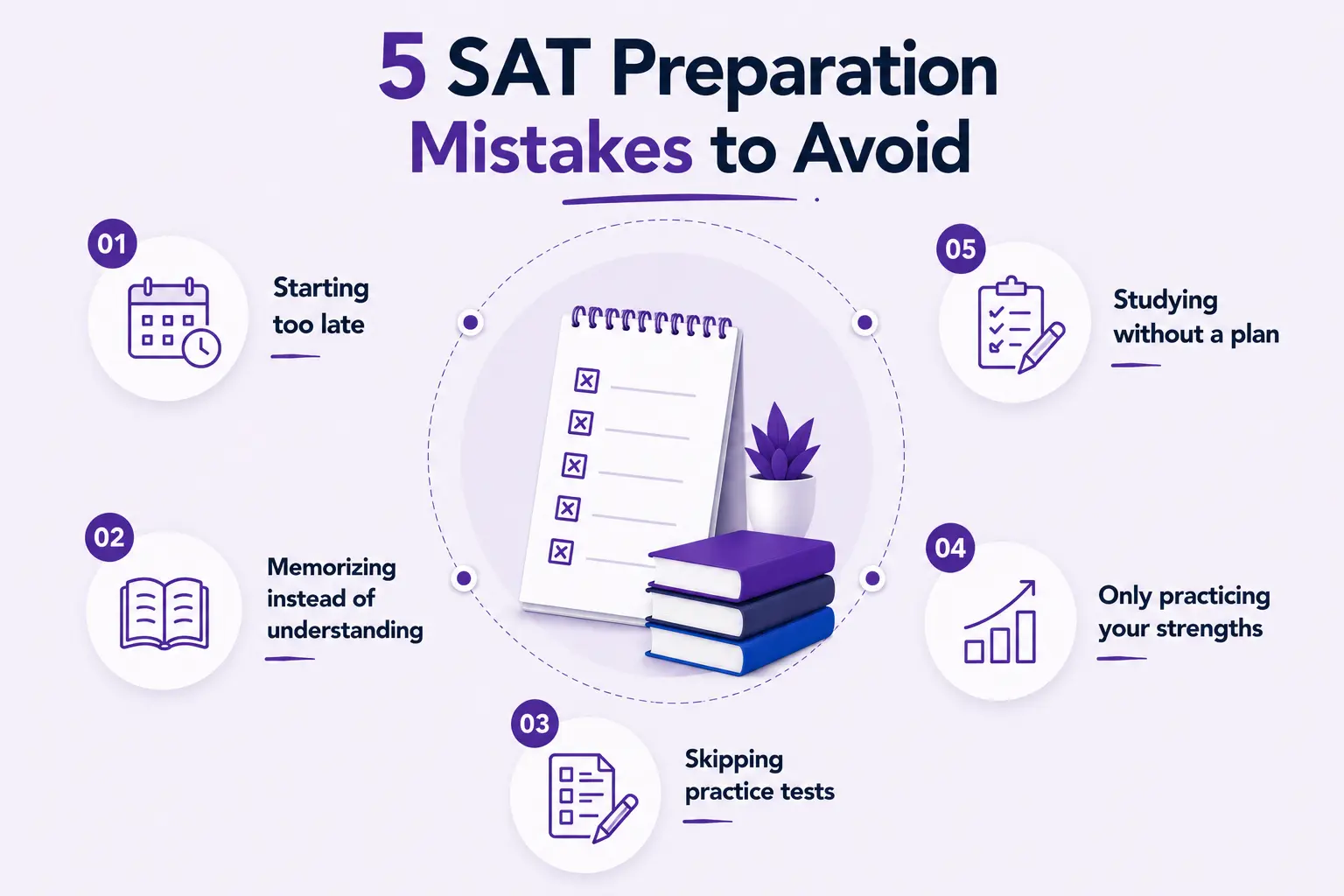
Common SAT Preparation Mistakes to Avoid
A few avoidable habits quietly cost students points.
- Starting too late: Cramming cannot replace steady practice. Give yourself months, not weeks.
- Memorizing instead of understanding: The SAT tests reasoning. Memorized facts fall apart on unfamiliar questions.
- Skipping practice tests: Without full tests, you never build pacing or stamina.
- Studying without a plan: Random effort spreads you thin. A plan points your energy at what matters.
- Only practicing your strengths: It feels good, but your score grows fastest when you attack your weak areas.
Seek2Lrn Tip: A structured learning plan prevents almost all of these mistakes at once. When your weeks are mapped out with clear goals, you naturally start early, cover your weak spots, and keep testing yourself instead of drifting.
One Month Before the SAT: Checklist
The final stretch is about sharpening what you know and staying calm, not learning new material.
- Revision: Review your error journal and your weakest topics. Do not try to cram new content now.
- Mock tests: Take one full-length timed test per week under real conditions.
- Sleep routine: Start sleeping well now, not just the night before. A rested brain scores higher.
- Exam day prep: Confirm your test center, install and update Bluebook, and know how the tools work.
- Documents and requirements: Get your admission ticket, photo ID, an approved calculator if you want a backup, and everything else ready a few days early.
Seek2Lrn Tip: To calm nerves before the exam, do a light review the day before instead of a heavy study session, then stop early. Trust the work you have already done. Walking in rested and relaxed helps more than one more late night of cramming.
Final Thoughts
The SAT rewards preparation and consistency far more than raw talent. Students who build a routine, practice with real tests, review their mistakes honestly, and ask for help when they get stuck are the ones who see their scores climb. None of that requires being a natural test-taker. It just requires a plan and the patience to follow it.
If you would like guidance along the way, Seek2Lrn connects you with experienced tutors who build your SAT prep around your specific goals and weak areas. Sometimes the fastest way to improve is to learn from someone who has helped students do it before. Wherever you study, start
early, stay steady, and trust the process. You have more control over your score than you think
